About the Creator of the Koontz Hollow Project

Rachelle Channell
Rachelle may be contacted through her LinkedIn profile or by submitting a contact form at the bottom of this page. She is interested in hearing from others on their own similar experiences with regard to eminent domain abuse.
Rachelle Channell was born and raised in Barbour County, West Virginia and has spent much of her life studying the history, families, historical landscapes, and traditions of Barbour County. Rather than fairy tales, many of her earliest lessons came from conversations with her grandmother Channell (nee Koontz) about local history, genealogy, family connections, historic cemeteries, and the folklore places that shaped the surrounding communities. Over time, she developed a deep knowledge of local family histories, historic burial grounds, settlement patterns, and the cultural landscape surrounding Koontz Hollow and Hunter's Fork. She continues to maintain a collection of historic maps, family records, photographs, genealogical materials, and local documentation that preserve the historical record of the area and support many of the historical observations and claims presented throughout this website.
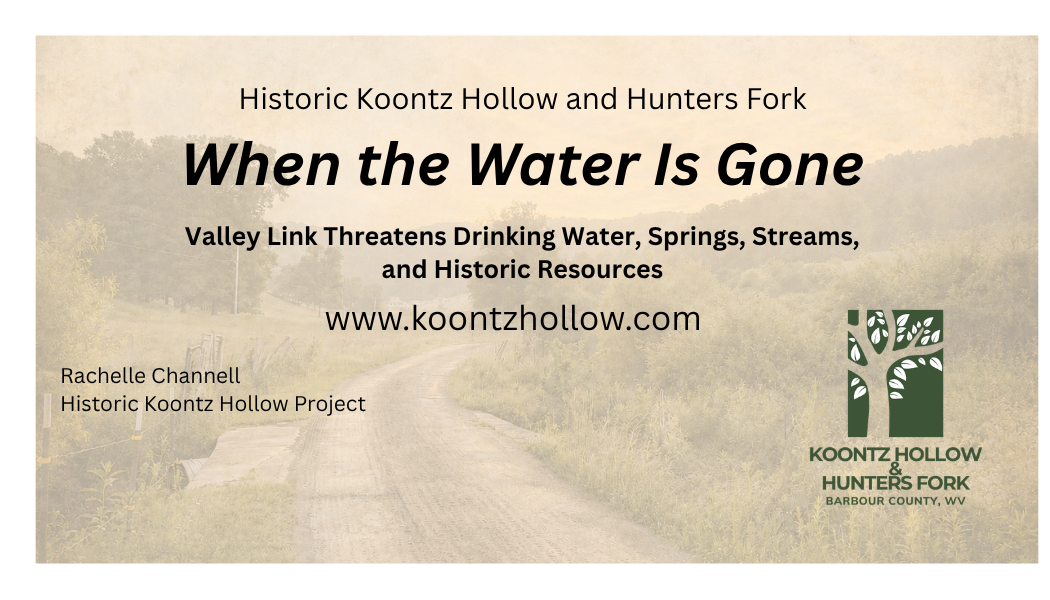
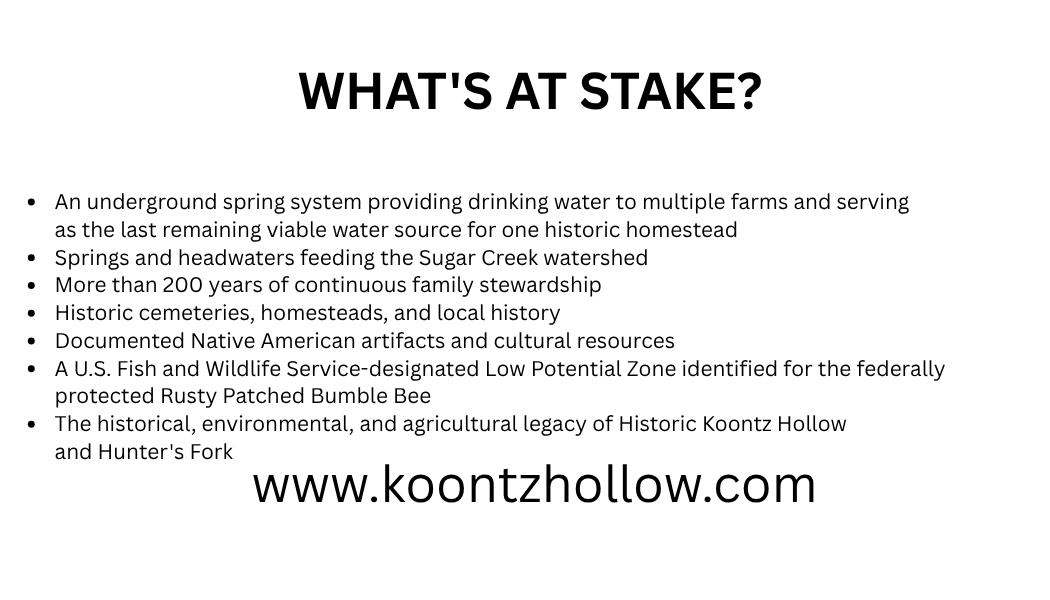
Her family's farm represents the last remaining portion of more than 200 years of continuous family ownership within Historic Koontz Hollow. The property contains the remaining spring originating on Koontz Hollow Ridge that supplies ponds and waterways which eventually feed tributaries of Sugar Creek. The underground spring also represents the last viable long-term water source for the homestead and is now threatened by the proposed Valley North corridor.
The property was previously identified along the proposed PATH transmission route in 2009. In 2025, Valley Link Transmission filed rate-related applications with the Federal Energy Regulatory Commission while utilizing maps that substantially mirrored the earlier PATH corridor through Koontz Hollow. After recognizing that the proposed route once again affected the property and surrounding community, Rachelle began contacting local, state, and federal officials, as well as Valley Link representatives, to document concerns involving drinking water, springs, historic resources, Native American artifacts, cemeteries, wildlife habitat, and the broader cultural landscape of Koontz Hollow and Hunter's Fork.
Although information regarding these resources had been provided prior to route notification letters, the property and surrounding landscape were again included within the proposed transmission corridor through West Virginia and Barbour County. This website was created to preserve the history, cultural resources, environmental features, and living landscape of Historic Koontz Hollow while documenting the potential impacts associated with the proposed transmission route.
Water is among the most essential resources supporting rural communities, family farms, and the continued habitability of historic properties. Because the remaining spring originating on Koontz Hollow Ridge represents the last viable long-term water source for the homestead and contributes to ponds, tributaries, and the greater Sugar Creek watershed, concerns regarding potential impacts to the groundwater system have remained a primary focus of her efforts.
As the project continues to advance, Rachelle is currently expanding her outreach efforts to include local officials, state agencies, elected representatives, federal offices, project representatives, community organizations, and members of the media in an effort to increase awareness of the historical, environmental, cultural, and water resource concerns affecting Historic Koontz Hollow and Hunter's Fork. To date, requests for meaningful discussion regarding these documented concerns, particularly those involving rural water, drinking water and the spring system, have not resulted in substantive engagement from Valley Link representatives. As public awareness of these issues continues to grow, discussions have increasingly extended beyond the local community to journalists and others interested in the broader effects of infrastructure development on rural communities, historic landscapes, and generational family farms.
Rachelle holds degrees in Psychology, Public Health, and Sociology and is currently a doctoral student in Sociology at West Virginia University, where she is completing comprehensive examinations and dissertation proposal work. Her research combines more than 30 years of professional experience with applied sociological research involving organizational systems, national security, workforce behavior, and the effects of power structures on individuals and communities.
Her academic research expands upon her professional experience through the study of espionage, corporate espionage, trade secret theft, organizational realignment through social geometry, and the ways human systems can be structured to support organizational stability, intellectual property protection, and national security.
She currently works with organizations on organizational stabilization through human systems design, workforce risk governance, and insider threat prevention and identification protocols in both cleared industry and commercial organizations.
Her broader research interests include extraction industries, corporate power and corruption, the use of eminent domain, marginalized communities, environmental impacts, medical disparities, trauma, and the ways large institutions affect rural populations, historic landscapes, and vulnerable communities. Her work increasingly focuses on the intersection of public policy, infrastructure development, rural communities, environmental stewardship, and the preservation of historical and cultural landscapes.
Additional information regarding her professional background, academic research, and consulting work may be found in her full professional biography or university profile.
Read Rachelle's full professional biography and university profile.